If you’re selling a home near the lake in Acworth, you’re not just putting another house on the market. You’re selling a location, an outdoor lifestyle, and in some cases, a set of access rights and permit details that buyers will look at closely. The good news is that with the right preparation, pricing, and presentation, you can make your home stand out for the right reasons. Let’s dive in.
Why lake-adjacent Acworth homes stand apart
Acworth’s identity is closely tied to Lake Acworth and Lake Allatoona. The city is known as the “Lake City,” and its parks, trails, beaches, and lake amenities play a big role in how buyers experience the area.
That matters when you sell. A home near the lake is often judged differently than a typical suburban listing because buyers may be comparing water access, views, recreation options, and convenience just as much as square footage or bedroom count.
Lake Allatoona is a major recreation draw with about 12,000 surface acres, 270 miles of shoreline, 27 public recreation areas, and eight full-service marinas. In Acworth, public lakefront amenities like Cauble Park and South Shore Park also shape buyer interest, especially for people who want easy access to beaches, fishing areas, trails, or boating.
Define the home’s water access clearly
One of the biggest mistakes sellers can make is using a broad “near the lake” label without explaining what that really means. Buyers want specifics, and the details can affect interest, pricing, and appraisal support.
Your home may fit into one of several different categories:
- True waterfront
- Dock-access property
- Walk-to-beach or walk-to-park location
- Near-lake home with nearby public access
- View-oriented home without direct access
These are not interchangeable in a buyer’s mind. A home with direct frontage or dock rights will usually be evaluated differently than a home that is simply a short drive from the water.
For that reason, your marketing should describe the exact relationship to the lake. Clear, accurate positioning builds trust and helps attract buyers who are looking for your specific kind of lake lifestyle.
Gather paperwork before listing
If your home is near Lake Allatoona and includes shoreline improvements or dock access, paperwork matters more than many sellers expect. Buyers often ask for these details early, and having them ready can help the sale move more smoothly.
The U.S. Army Corps of Engineers manages shoreline permits at Allatoona for items such as docks, walkways, steps, grass mowing, underbrushing, and shoreline protection in limited-development zones. Those permits can involve renewals, modifications, and changes of ownership.
If you have any shoreline-related feature, gather documents before you go live, including:
- Current dock or shoreline permits
- Records of permit renewals
- Written approvals for any modifications
- Documents tied to ownership transfer requirements
- Invoices or records for shoreline or exterior improvements
This is especially important because unapproved permit changes may have to be removed. It is also important to confirm what actually transfers with the home, since the Corps notes that a dock may be privately owned while the land it connects to remains public land.
Check permits for past exterior work
Lake-adjacent homes often have more exterior upgrades than standard suburban homes. Decks, retaining walls, drainage improvements, shoreline stabilization, stairs, and walkways can all raise questions during buyer due diligence.
In Acworth, permits are required for additions, decks, electrical work, plumbing work, and other structural changes. The city also notes that permitting helps ensure compliance with zoning, stormwater, and floodplain rules.
Before listing, it is smart to organize records for any work that may have needed approval. If a buyer sees outdoor improvements but the documentation is missing, that can create delays or extra concern during inspections.
Review flood status early
Flood risk is another area where early preparation can save time and stress. Every property has some flood risk, and mapped flood zones can affect both buyer financing and insurance requirements.
High-risk flood zones generally require flood insurance for federally backed mortgages. Because flood maps can change over time, it is best to verify your property’s current flood status before you set a price or market the home.
This step helps you prepare for common buyer questions and reduces the chance of surprises later in the process. It can also help shape expectations if your home’s flood profile differs from other nearby listings.
Price by access type, not by assumption
Acworth market data shows a range of price signals depending on the source. Recent public trackers report median sale price, average value, and median listing price figures that do not perfectly match, along with market times that range from roughly the low 30s to low 40s in days on market.
That is a good reminder that broad headlines do not price a specific home. For a lake-adjacent property, pricing should be built around recent comparable sales that truly match your home’s access type, condition, and location traits.
This matters because buyers do not value all “lake homes” the same way. Features like direct frontage, dock rights, view, lot shape, and flood exposure can all influence what buyers are willing to pay.
A strong pricing strategy usually looks like this:
- Start with recent sold comps, not active listing hopes
- Match homes by lake access type
- Compare condition and exterior improvements carefully
- Account for flood zone differences where relevant
- Support any premium with actual market evidence
Even in a market with healthy buyer activity, overpricing can slow momentum. A lake-adjacent home can attract strong attention, but buyers still expect the price to make sense for the exact feature set.
Expect appraisal questions
Appraisals for lake-adjacent homes can be more complex than appraisals for more typical suburban properties. When truly similar sales are limited, the appraiser may need to expand the search area and explain any location adjustments.
Comparable sales should have similar physical and legal characteristics whenever possible. External factors, including FEMA flood zone, can also affect how value is analyzed.
For you as a seller, that means the best defense is preparation. If your home has a legitimate value advantage, such as stronger water access, permitted dock rights, or a superior lot relationship to the lake, those details should be documented clearly from the start.
Present the exterior with extra care
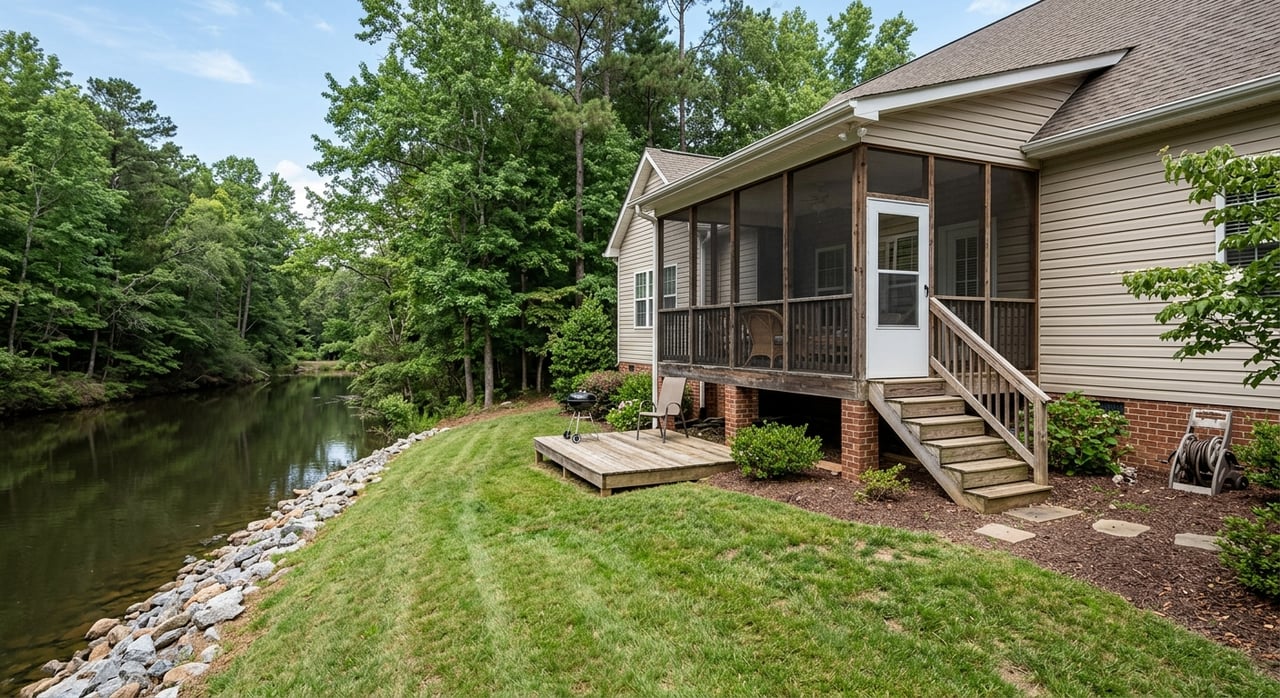
Outdoor condition carries more weight with lake-adjacent homes. Buyers often look closely at grading, slopes, retaining walls, walkways, drainage paths, shoreline edges, and signs of erosion or washout.
Acworth’s stormwater program focuses on flooding, erosion, and water pollution, which reflects how important exterior water management is in this setting. If your yard or shoreline-facing areas look tidy, stable, and maintained, buyers are less likely to assume hidden problems.
Before showings, focus on visible exterior readiness:
- Clean up leaves, branches, and shoreline clutter
- Make walkways and stairs feel safe and stable
- Tidy landscaping so drainage paths are easy to see
- Address visibly improvised repairs
- Neaten retaining walls, edges, and slope transitions
These steps do not just improve appearance. They also help reduce friction during inspections and buyer walk-throughs.
Market the lifestyle accurately
Acworth’s public identity is built around water access and recreation. Buyers are often drawn to the area for swimming, fishing, boating, sailing, trails, beaches, and park access.
That gives you a useful marketing angle, but accuracy matters. Instead of using generic wording, your listing should show exactly how your home connects to the lake experience.
For example, buyers may want to know whether the home offers:
- Direct waterfront positioning
- Dock access and permit status
- Close proximity to Cauble Park or South Shore Park
- Convenient access to fishing areas or trails
- Access to an electric-motor-only boat ramp at Cauble Park
- A practical route to marinas or broader Allatoona recreation
This kind of detail helps buyers picture daily life in the home. It also avoids the confusion that can happen when “lake area” means very different things from one listing to another.
Use visuals that answer questions fast
Online presentation is especially important for homes near the lake because buyers often sort options based on access and setting before they ever schedule a showing. Your photos and visual materials should help them understand the property quickly.
The most helpful visuals usually include:
- Exterior images that show the lot and approach
- Backyard or side-yard photos that explain slope and usable space
- Aerial views showing the home’s position relative to the water
- Clear images of any dock, walkway, or shoreline feature
- Context photos showing proximity to parks or access points when relevant
The goal is simple. Buyers should be able to tell whether your home is waterfront, dock-access, walkable to public amenities, or simply nearby.
Prepare for buyer questions
Lake-adjacent listings tend to generate more detailed questions than standard suburban homes. That is not a bad thing. It usually means buyers are serious and trying to understand exactly what they are getting.
Be ready for questions about:
- Whether a dock transfers automatically
- Whether permit changes or fees apply after closing
- Whether flood insurance may be required
- Whether past exterior work was permitted
- How the home compares to other nearby lake listings
- What kind of water access the property truly offers
When you can answer these questions clearly and support the answers with documentation, your listing feels more credible. That confidence can help buyers move forward with fewer delays.
What to expect overall
Selling an Acworth home near the lake usually means a little more prep, a little more detail, and a little more strategy than a standard sale. But it also gives you something powerful to market: a location tied to one of the city’s most recognizable lifestyle draws.
When you combine accurate pricing, complete paperwork, strong exterior presentation, and a clear explanation of the home’s relationship to the water, you give buyers what they need to feel confident. That can make your listing easier to understand, easier to show, and easier to defend during due diligence.
If you’re thinking about selling your lake-adjacent home in Acworth, working with a local agent who understands how to position the property clearly can make a real difference. For professional guidance, polished marketing, and a local approach built around your goals, get your free home valuation from Aretha Langley.
FAQs
What makes selling a lake-adjacent home in Acworth different?
- A lake-adjacent home in Acworth is often marketed as both a residence and a lifestyle property, so buyers pay close attention to water access, views, outdoor condition, permits, and flood-related details.
What paperwork should sellers gather for an Acworth home near Lake Allatoona?
- You should gather shoreline and dock permits, renewal records, written approvals for modifications, and documentation for exterior improvements that may affect access, compliance, or transfer.
What should sellers know about dock transfers for Acworth homes near Allatoona?
- A dock does not necessarily transfer automatically, and a change of ownership may trigger a new permit-holder process and fee under the U.S. Army Corps of Engineers rules.
What flood questions should sellers expect for an Acworth lake-area home?
- Buyers may ask about the property’s current flood zone, whether flood insurance could be required for financing, and how flood status compares with nearby homes.
How should sellers price a home near the lake in Acworth?
- The safest approach is to use recent sold comparable homes that match the property’s access type, condition, and flood profile rather than assuming every lake-area home earns the same premium.
What should marketing highlight for a lake-adjacent Acworth listing?
- Marketing should clearly explain whether the home is true waterfront, has dock access, is walkable to parks or beaches, or simply offers convenient proximity to the lake and recreation areas.